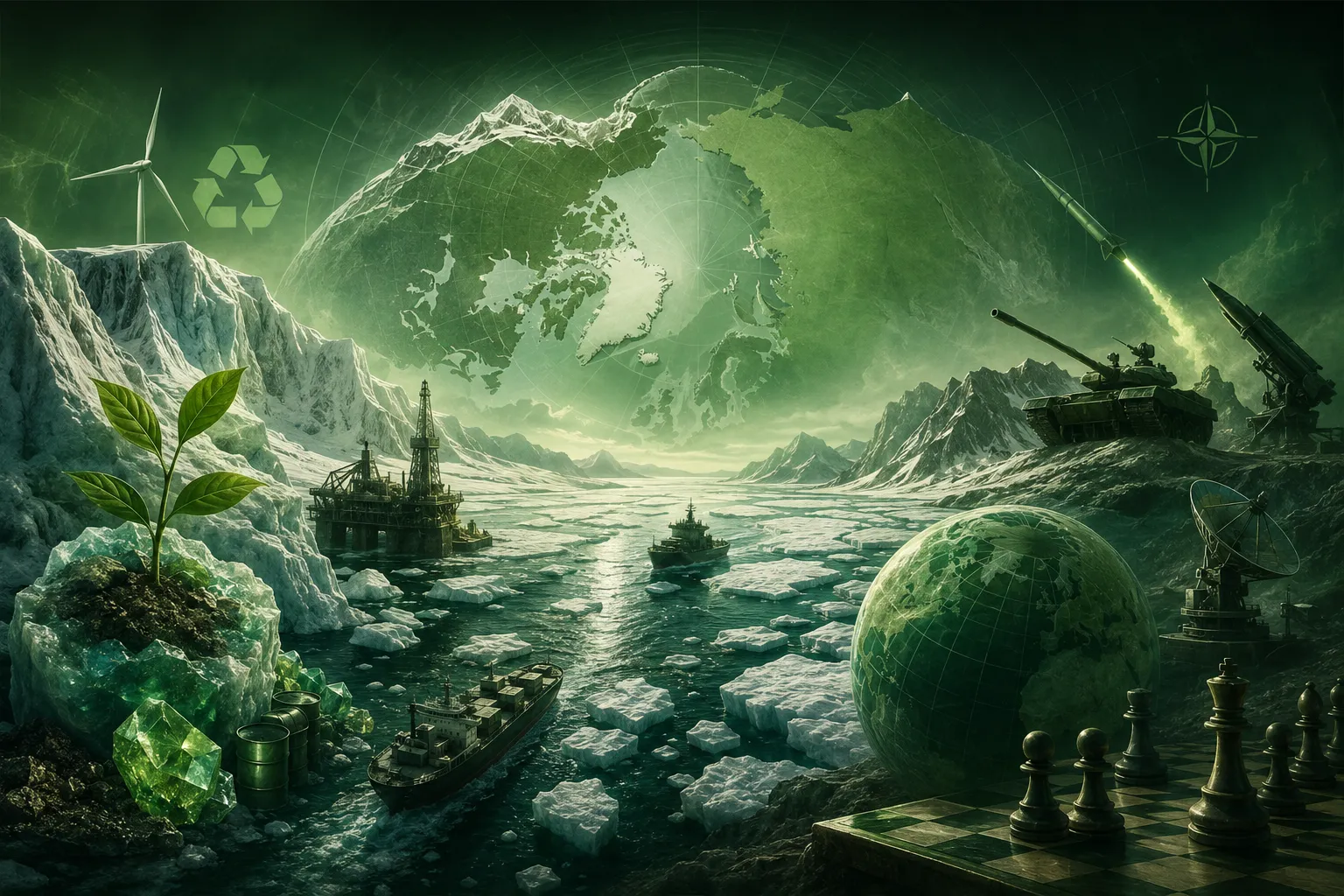
For centuries the Arctic was the last frontier for mankind, a vast frozen expanse that was more a barrier to civilization than a resource for it. That era is definitively ending. With climate change melting polar ice at an unprecedented pace, the region is transforming profoundly, moving from a passive, icy desert to a contested geopolitical chessboard. Three factors the global need for rare earth minerals, the emerging transpolar shipping lanes, and the crumbling legal architecture left behind by the Cold War have come together to spark a new “Great Game” in the High North, a low key but intensifying race for supremacy among Russia, the United States, China and regional powers. The main driver of this new competition is economic, driven by the world’s transition to green technology. The Arctic’s thawing permafrost and seabed conceal immense deposits of nickel, cobalt and rare earth elements, crucial components for electric vehicles, wind turbines and sophisticated defense systems. The region is estimated to hold some 13 percent of the world’s undiscovered oil and 30 percent of its natural gas, as well as a huge share of the world’s deposits of rare earths. For Russia, which controls half the Arctic coastline, these resources represent a strategic hedge against Western sanctions and a path to energy hegemony. At the same time, China, a geographically “near-Arctic” state, has aggressively asserted itself as a major stakeholder, with large investments in Russian gas projects (such as Yamal LNG). For Russia, which has half the Arctic coastline, these resources are both a strategic hedge against Western sanctions and a path to energy dominance. At the same time, China, a geographically “nearArctic” state, has aggressively sought to present itself as a major stakeholder, investing heavily in Russian gas projects (e.g. Yamal LNG) and portraying itself as a key partner in polar silk road initiatives. But this economic gold rush is taking place in a very fragile environment. Oil spills are nearly impossible to clean up in ice-covered waters, and the extraction of key minerals risks releasing massive stores of methane from the permafrost, possibly accelerating the very climate crisis that makes extraction viable. At the same time, melting ice is reshaping the world’s maritime map, triggering a strategic scramble for trade routes that could rival the Suez and Panama canals. The Northwest Passage, through the Canadian archipelago, and the Northern Sea Route, along Russia’s northern coast, are becoming more navigable for longerperiods of time each summer. These routes could cut shipping times between Asia and Europe by up to 40%, a game-changer for global logistics. But the legal and governance regimes that govern these waters are dangerously old. Under the UN Convention on the Law of the Sea (UNCLOS), coastal states have exclusive rights to their continental shelves out to 200 nautical miles, and possibly further, if they can show the seabed is a natural extension of their landmass. That has sparked a flurry of competing scientific claims, especially over the Lomonosov Ridge, an underwater mountain range that Russia, Canada and Denmark each claim as an extension of their own continental territory. The UN Commission on the Limits of the Continental Shelf has been hamstrung by political tensions and a backlog of submissions, which has allowed legal grey areas to proliferate and has raised the spectre of jurisdictional chaos in the most lawless marine spaces. The militarization of the region raises the geopolitical temperature further. For decades the Arctic was celebrated as a "zone of peace" where scientific cooperation and environmental stewardship reigned. That consensus has broken down since Russia’s invasion of Ukraine, effectively putting the Arctic Council, the region’s main intergovernmental forum, on ice. In response, Russia has dramatically expanded its network of Soviet-era military bases along its northern flank, refurbished airfields and installed advanced hypersonic missile systems. For Moscow, the Arctic is not just an economic frontier, but also a critical strategic bastion for its nuclear submarine fleet, offering a second-strike capability that is vital for the country’s national security. This has prompted NATO members, specially the United States, Norway, and Canada to kind of similarly bolster their presence, with more joint exercises and further investment in specialized icebreaker fleets. China though, while it doesn’t have a direct Arctic coastline, is nevertheless getting deeper leverage through its polar research stations and the rollout of a very sophisticated icebreaker fleet, ostensibly for scientific research but most people see it as a way to collect bathymetric data in order to improve submarine performance and secure a real position within the region’s emerging governance structures. Honestly, any full analysis of the Arctic has to face the deep philosophical and humanitarian side of the whole “scramble.” The priorities of nation-states so often crash into the rights and plain survival of the region’s Indigenous peoples the Inuit,Sámi, and Yupik, who have lived and thrived in these ecosystems for millennia. For these communities, the melting ice doesn’t just mean some commercial angle or an opening for extraction, it feels like an existential breakdown. It threatens hunting corridors, it disrupts how marine mammals move, and it even destabilizes the coastal settlements they call home. Meanwhile, as outside powers sort of carve up the seabed and send industrial ships in with flags raised, sovereignty becomes something more tangled. It isn’t only a matter of who holds the mineral entitlements under the ocean floor, but rather who gets the moral authority to steer what comes next for the region. A development model that doesn’t include Indigenous consultation, can end up repeating a colonial story while calling it green progress. Ultimately, “New Scramble for the Arctic” still isn’t a conventional military conflict , but it feels like this dangerously volatile collision of ambition and necessity. The region is kind of the ultimate litmus test for international law, and climate justice too, in the 21st century. Yet if the international community can’t bring back some cooperative framework rebuilding and recalibrating then the Arctic might not become a place of sustainable development. Instead it could turn into a theater of strategic competition, where the melting ice doesn’t just reveal resources but also sows the seeds for a new and chilling Cold War.
Category:Saya